Answers to questions researchers, peer reviewers, and institutional boards ask.
11 · Frequently asked questions
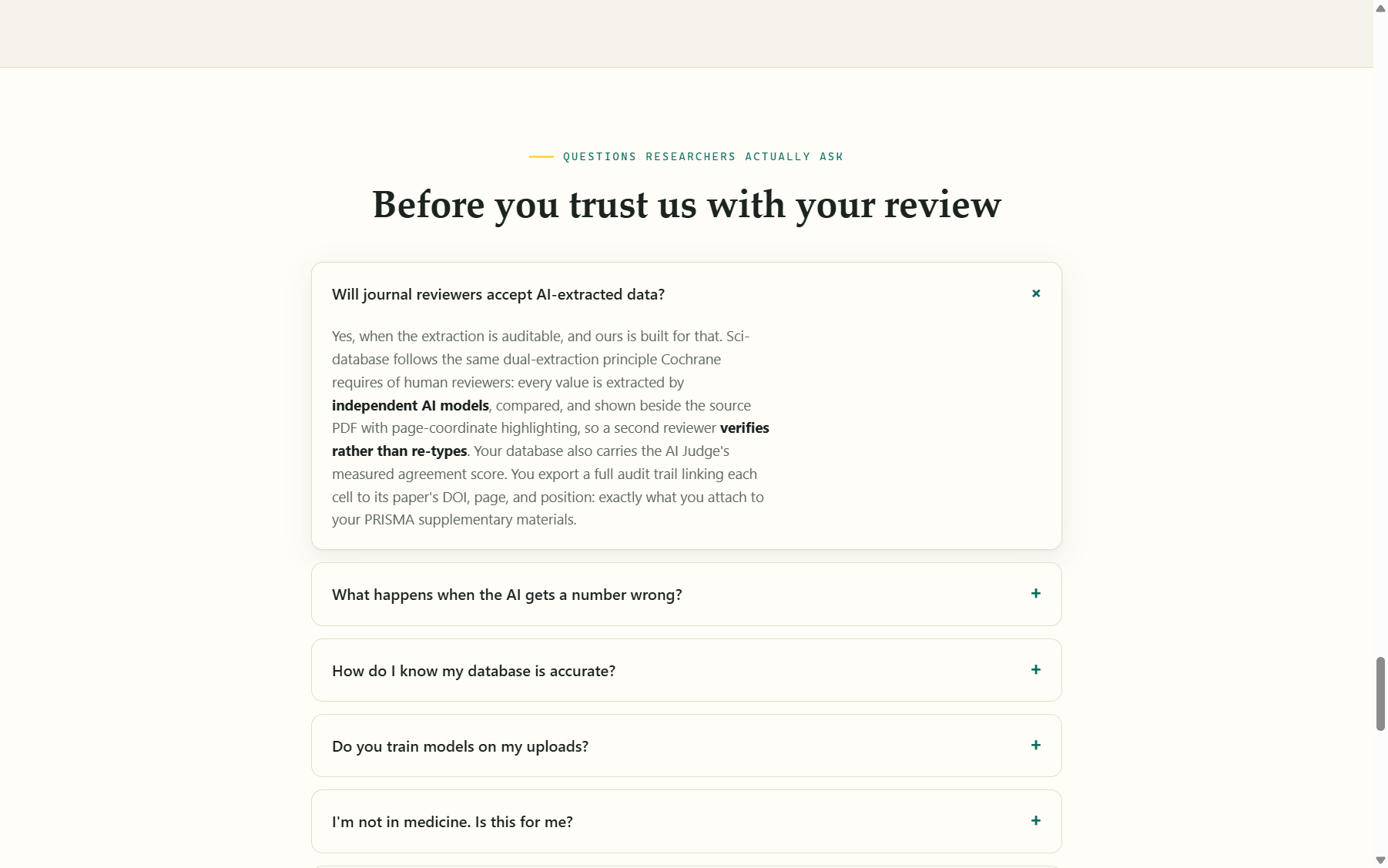
Will journal reviewers accept AI-extracted data?
The workflow is designed to be defensible: two independent AI models extract the same papers (mirroring the dual-extraction practice of Cochrane reviews), every disagreement is flagged for your review rather than silently resolved, and the downloadable validation report documents field-by-field agreement. You stay the final adjudicator — the platform just does the reading.
What happens when the AI gets a number wrong?
That's exactly what validation is for. The second model re-extracts a random sample; any field where the two models differ is highlighted red in a comparison table. You can hand each conflict to the AI Judge (which must justify its resolution from the paper text) or decide yourself. Wrong numbers don't survive the loop silently.
How do I know my database is accurate?
Run validation and look at one number: the cross-model agreement percentage. Below ~90%, refine your schema descriptions (the platform will suggest improvements) and re-run. Above 90% — the platform's trust threshold — remaining disagreements are hard judgment calls you have personally resolved, with an audit trail.
Do you train models on my uploads?
No. Your papers and extracted data are never used to train models, and they stay private to your account unless you explicitly share a database.
I'm not in medicine. Is this for me?
Yes. The schema system is domain-agnostic — the public gallery already includes thermoelectric materials, dental composites, supernova observations, IoT security, climate model projections, and more. If your field publishes papers, you can build a database from them.
Why did some of my papers fail verification?
Their PDFs aren't openly fetchable by the server (typically paywalled publisher links). Open them with the 👁 button, download manually, and drag them into the Files tab dropzone — problem solved. See Files & uploads.
Can one paper produce more than one row?
Yes — the extractor is instructed to find all distinct records matching your schema. A paper reporting five materials or three patient cohorts yields five or three rows, each carrying the paper's reference.
How do credits work?
1 credit = 1 paper, regardless of how many fields you extract. New accounts get 100 free credits (+50 for completing your profile, +50 for a social share). Validation and the AI Judge cost extra credits because they are additional model runs — see Credits & pricing.
What do I get out at the end?
A clean spreadsheet: CSV that opens in Excel (or JSON for pipelines), one row per extracted record, columns exactly matching your schema, a source reference on every row — ready for R (meta), Stata, RevMan, or pandas. It's also emailed to you automatically when the job finishes.
What languages do the papers need to be in?
The extraction engine reads papers in 100+ languages and returns your database in the language of your schema.
Next: Troubleshooting →